Everyone has lookalikes, and if you’re a white man of a certain archetype living in Wellington, NZ, like me, you might have more than most. But sometimes I have to disagree when a doppelgänger is pointed out. He just doesn’t look like me. I mean sure, he’s got a beard, but really? Not close at all. He’s standing all the way over there.
So I invented a unit. Which, to be fair, is something that anyone who looks like me would probably do.
Introducing the Doppelgänger Discriminating Distance (DDD): the distance at which you can no longer tell two people apart. Start next to them, walk backwards until they merge, then measure how far you got.
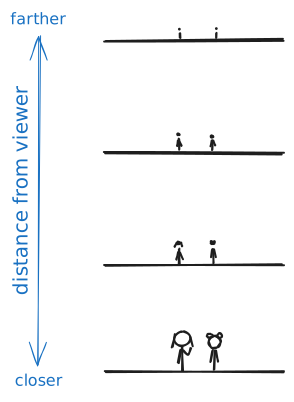
A good lookalike has a small DDD. The pair become indistinguishable after only a few steps back. Two people who look nothing alike stay distinguishable much further out. By this measure, the bearded man and I have a DDD of roughly the length of Cuba St.
This works because distance is a blur filter, so as two people get farther away, finer details disappear and only the coarse details remain, such as body shape or presence of dark facial hair.
If you want to get technical about it, and I know all my white, bearded, glasses-wearing doppelgängers out there do, normal eyesight resolves about one arcminute, roughly 0.0003 radians. We can divide a feature’s size by that and get the distance at which it disappears:
- a 1 cm difference (a hair clip, an earring) vanishes at about 35 m
- a 10 cm difference (a hairstyle) vanishes at about 350 m
A DDD of 35 m therefore means the only thing separating two people is something about the size of a hair clip. And who said trigonometry would never be useful in day-to-day life.
The best part is that the DDD is an objective measure of similarity (or dissimilarity) so long as you control for lighting, movement, observer, and clothing.
Distance works both ways. Almost everyone is a doppelgänger of mine if they’re far enough away! Did you know I look just like Emma Stone and The Rock?